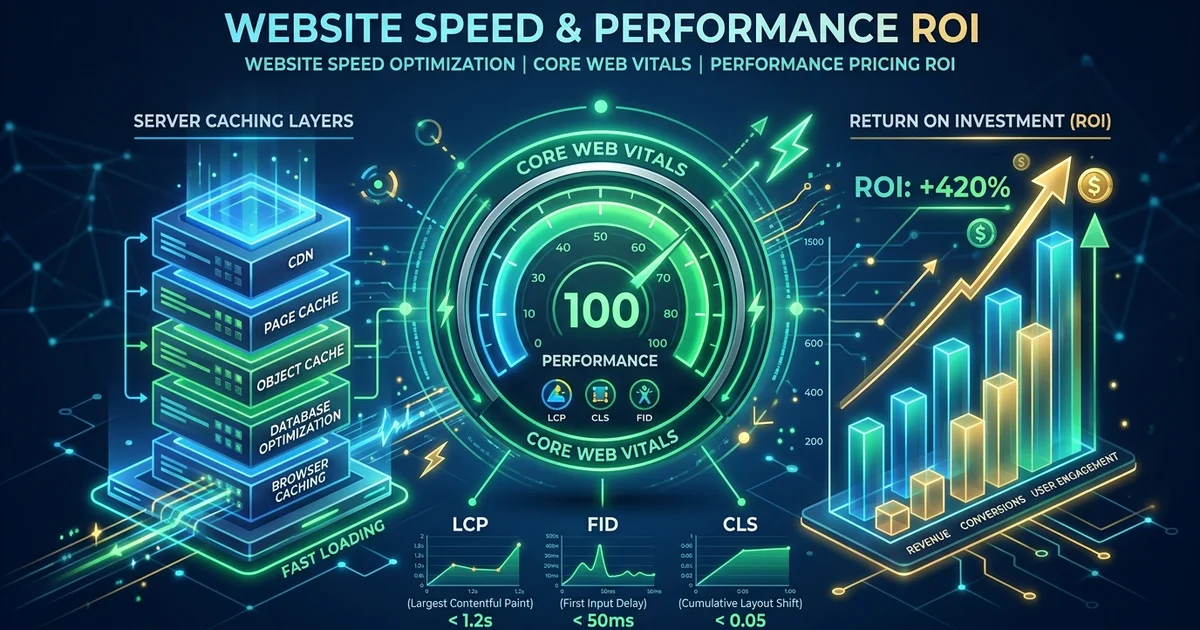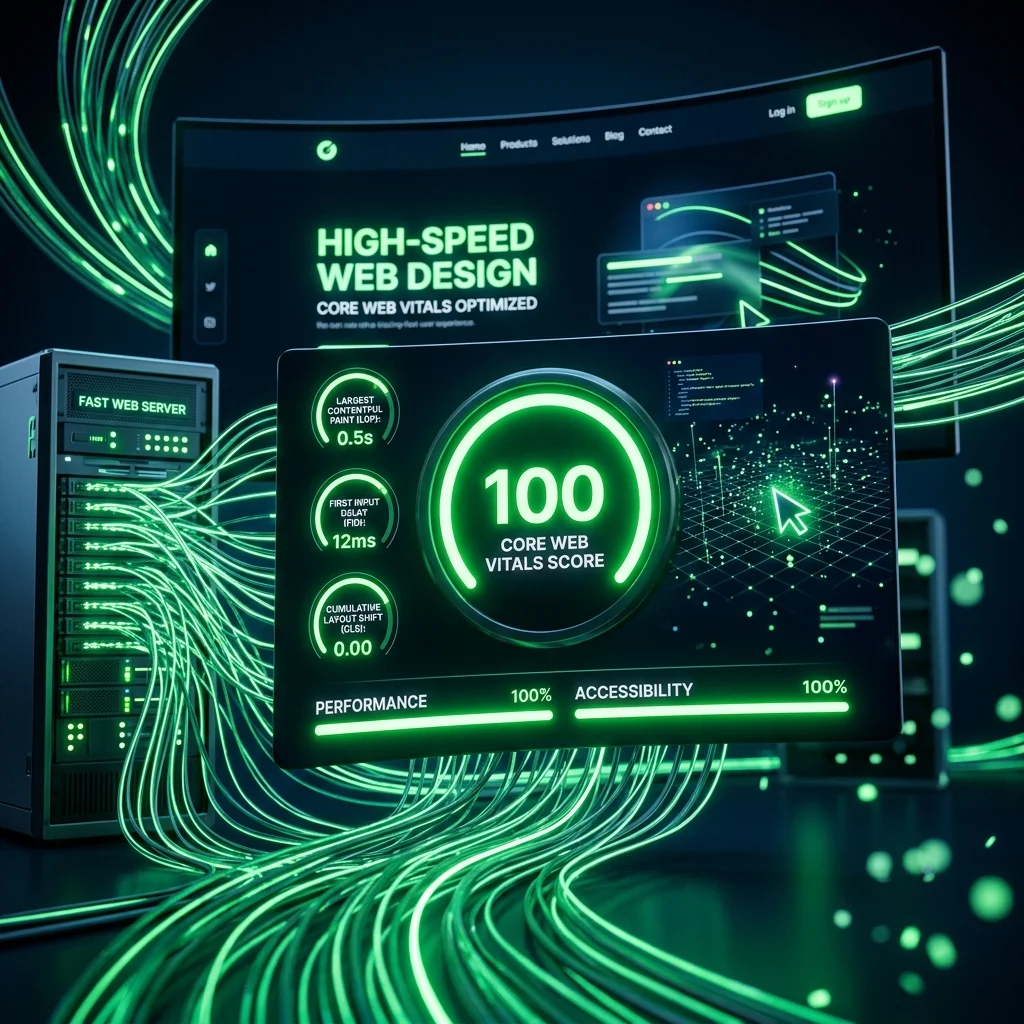
Website performance in 2026 is a ranking factor and the single highest contributor to online conversion rates, not a technical luxury. As Google’s algorithm prioritizes seamless real-time user experiences, mastering Core Web Vitals is table stakes for any competitive online business.
Whether running a high-traffic regional e-commerce store or a custom SaaS portal, optimizing page rendering speeds delivers immediate competitive advantages in search visibility and revenue attribution. This guide is the procedure: measure first, fix in a specific order, then hold the line. If you need to budget the work rather than perform it, see our website speed optimization pricing guide.
1. Understanding Core Web Vitals Benchmarks
Google scores real-user experience with three metrics: Largest Contentful Paint under 2.5 seconds, Interaction to Next Paint under 200 milliseconds, and Cumulative Layout Shift under 0.1. Pass all three in field data and speed stops being a ranking liability; fail any one, and the rest of this guide prioritizes around it.
Largest Contentful Paint (LCP)
- Target Threshold: Under 2.5 seconds.
- Optimization Strategy: Preloading critical HERO assets, optimizing server response times (TTFB), and caching static assets on global Content Delivery Networks (CDNs).
- How to verify: LCP is measured on the largest image or text block in the viewport, so check what the report names as the element before you optimize the wrong one.
Interaction to Next Paint (INP)
- Target Threshold: Under 200 milliseconds.
- Optimization Strategy: Minimizing heavy JavaScript main-thread execution, deferring non-essential scripts, and refactoring third-party tracking pixels.
- How to verify: Lab runs rarely reproduce INP. Test by clicking real controls — menus, filters, cart buttons — and watch the responsiveness report for the interaction that scores worst.
Cumulative Layout Shift (CLS)
- Target Threshold: Under 0.1.
- Optimization Strategy: Reserving explicit width and height dimensions for all image and video containers to eliminate unexpected visual layout shifts during page loading.
- How to verify: Scroll a page on a throttled connection. Anything that jumps while loading — banners, cookie bars, injected ads — is a shift you can point at.
2. Measure First: Build a Speed Baseline
Start by recording what the site does today, because every fix that follows is judged against this baseline. Run PageSpeed Insights on your slowest important page, note the three Core Web Vitals scores, TTFB, and the failing opportunities list, then repeat on a passing page for contrast.
- Pick three test pages. A template of each type you publish: a post or product, a category or archive, and the home page. Optimization decisions made from one page miss template-level problems.
- Run a mobile lab test first. Mobile is where scores fail and where the throttled profile exposes blocking resources that desktop hides.
- Read the waterfall, not just the score. A single number tells you nothing about sequencing. Look for what arrives first, what blocks rendering, and which requests are largest.
- List the top three offenders. By transfer size, by blocking time, or by third-party origin. Three fixes beat a list of forty you never start.
- Compare lab results with field data. Lab data is a controlled simulation; field data is what real visitors on real devices experience. Trust field data for decisions and lab data for debugging.
- Save everything. Screenshots, report URLs, and dates. Without a saved baseline you cannot prove the work moved anything.
3. Optimize Images and the Critical Render Path
Images are usually the largest bytes on the page, so they come first: convert to WebP or AVIF, serve responsive sizes with srcset, reserve dimensions before load, and let the hero image load with priority while everything below the fold waits. This step alone addresses LCP and CLS together.
- Convert legacy assets. Upgrade all site media to next-gen WebP or AVIF in the build pipeline or CDN, not by hand at upload time.
- Serve the right size. Responsive srcset and sizes attributes stop phones from downloading desktop imagery. Check the breakpoint math; a wrong sizes value defeats the whole attribute.
- Reserve space. Explicit width and height on every image, video, and embed container so nothing reflows after paint.
- Prioritize the hero. Load the LCP element with fetchpriority high, and never lazy-load it. Lazy-loading below the fold is correct; lazy-loading the element you are scored on is self-sabotage.
- Inline the critical stylesheet. The CSS needed to paint the first viewport goes inline or in a preload; everything else loads asynchronously.
Common failure mode: an image plugin that converts uploads but leaves the old files referenced from cached pages, so both versions ship. Re-run the baseline after this step before moving on.
4. Control JavaScript and Third-Party Scripts
Render-blocking JavaScript delays the first paint, so ship less of it to the main thread: defer what is not needed at load, split bundles by route, and move tracking pixels to asynchronous tags. Third-party scripts — analytics, chat widgets, A/B tools — are usually the biggest offenders on business sites.
- Find the blocking scripts. The coverage panel or the opportunities list shows what executes before first paint and what never gets used at all.
- Defer and async correctly. Defer for scripts that must run in order after parsing; async for independent ones. A blanket async on a dependency breaks the page in subtler ways than a slow score.
- Split and tree-shake. Code-splitting by route and dropping dead CSS keeps each page’s bundle proportional to what it renders.
- Tame third parties. Load chat, heatmaps, and A/B tools after interaction or on consent, and audit them quarterly: one vendor’s tag update can undo a month of tuning.
- Validate your data payloads. Broken or bloated JSON fed to the front end costs parse time on the main thread — check payloads with our JSON Formatter & Validator.
INP lives here. Every handler that runs on the main thread delays the next paint after a tap, so responsiveness improves when you reduce work per interaction, not when you add animation to mask it.
5. Server Response: Caching, TTFB, and HTTP/3
If the browser waits on the server, nothing else you do will feel fast. Reduce time to first byte with full-page caching on the server or edge, serve static assets over a CDN with long cache lifetimes, enable compression, and move the site to HTTP/3 where the host supports it.
- Cache the page, not just the assets. Full-page or edge caching removes PHP and database work from the request path entirely.
- Set explicit cache headers. Static assets get long lifetimes plus content-hashed filenames; HTML gets short, revalidating lifetimes so publishes show up.
- Compress at the edge. Brotli or gzip on text resources, and confirm the CDN is not serving uncompressed duplicates of compressed files.
- Fix invalidation before it fixes you. The most common post-optimization regression is a stale cache serving old templates after a deploy. Purge on publish and test logged-in versus logged-out paths.
6. Real-World Case Study: Speed Transformation
The clearest proof is work we ran ourselves: on Mehromah Qazvin, a major regional commercial center, reducing mobile page load times from 4.8 seconds to 0.6 seconds led to a 210% increase in organic search traffic and a 45% reduction in bounce rate.
The engagement followed the sequence in this guide rather than a plugin install: baseline measurement first, then image and render-path work, then script control, then server response and caching, and finally a checklist the client’s team could run after every publish. That last step is what kept the gain from decaying.
Explore our dedicated Website Speed Optimization Services or learn about our complete Web Development Solutions.
7. Actionable 2026 Speed Checklist
Run this checklist top to bottom after every significant redesign or plugin change. It covers the four layers this guide walked through — images, scripts, layout dimensions, and markup — and it is short enough to complete in a single working session on a staging copy.
- Convert Legacy Images: upgrade all site media to next-gen WebP or AVIF assets.
- Eliminate Render-Blocking Scripts: move tracking pixels and third-party tags to deferred asynchronous loading.
- Enforce Container Aspect Ratios: prevent layout shifts by specifying explicit image and video dimensions.
- Audit Technical Code: validate clean HTML/CSS markup with our Developer Tools.
- Verify the LCP Element: confirm the largest viewport element loads eagerly and early, not behind a slider or lazy-load.
- Preload One Font Family: self-host it, preload only the weights you use, and set a fallback that does not reflow.
- Purge and Warm the Cache: clear stale output after deploys, then request the key templates once.
- Re-test on Throttled Mobile: desktop passes hide the failures that real visitors hit on cellular connections.
- Check Search Console Reporting: confirm the Core Web Vitals field report no longer flags the templates you fixed.
- Document What You Changed: dates, fixes, and scores, so the next regression has a diff to read.
8. Maintaining Speed After Launch
Speed decays through ordinary use, not one catastrophic event: an unoptimized banner upload, one more tracking script, one plugin update that adds a stylesheet. Prevent that with publishing rules — compress before upload, vet scripts before install, re-measure on a schedule — and re-run the baseline after every template change.
- Compress before upload. A media library rule beats any later optimization pass, because originals are never re-encoded twice.
- Vet scripts at install time. Every tag manager addition is a permanent tax on the main thread; require a reason and a review date.
- Re-run the baseline monthly. Ten minutes on the three test pages from step two catches drift while it is still one script, not a rebuild.
- Re-test after template changes. Redesigns reintroduce unsized images and inline blocking CSS faster than any other change.
- Keep the checklist in the publishing workflow. Speed that depends on one engineer’s memory is speed you lose when that engineer moves on.