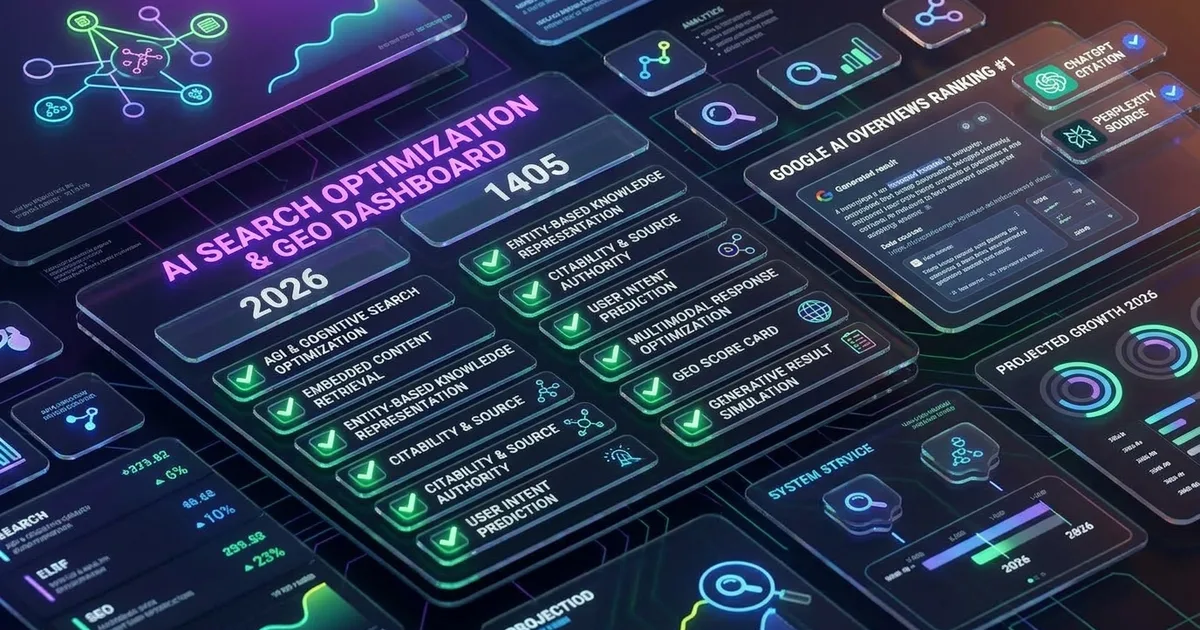
The search landscape in 2026 has crossed a permanent threshold: ranking in Google’s traditional ten blue links is no longer sufficient. Today, over 40% of conversational and informational search queries trigger Google AI Overviews, while millions of decision-makers use Perplexity, SearchGPT, and Claude as their primary research engines.
To thrive in this environment, digital brands must master Generative Engine Optimization (GEO) and Answer Engine Optimization (AEO). This comprehensive guide details the mechanics of generative search engines, provides battle-tested blueprints for earning authoritative citations, and outlines an actionable technical checklist for 2026.
Quick Summary (TL;DR):
- GEO = Optimization for AI Citation: Craft modular content designed to be extracted, summarized, and credited by LLMs.
- The Winning Blueprint: 40–60 word direct answers under question H2s + comparison tables + schema markup + primary data points.
- Crawlability is Mandatory: Permit AI retrieval bots (
GPTBot,PerplexityBot,Google-Extended) and maintain sub-second server response times.- Entity Authority Outranks Keyword Density: Solidify your brand’s Knowledge Graph footprint across Wikidata, industry directories, and authoritative press.
What is Generative Engine Optimization (GEO)?
Generative Engine Optimization (GEO) is the systematic process of structuring, authoring, and technically formatting website content to maximize its visibility, citation frequency, and referral traffic within AI-powered answer engines—including Google AI Overviews, OpenAI SearchGPT, Perplexity AI, and Anthropic Claude.
Unlike traditional SEO, which optimizes an entire URL to win a link position on a Search Engine Results Page (SERP), GEO optimizes atomic content passages (sentences, tables, data points) so generative models can ingest, parse, and cite them inside an AI synthesis.
┌─────────────────────────────────────────────────────────────────────────┐
│                      Traditional SEO vs. Modern GEO                     │
├─────────────────────────┬───────────────────────────────────────────────┤
│ Dimension               │ Traditional SEO (1998–2024)                   │
├─────────────────────────┼───────────────────────────────────────────────┤
│ Primary Target          │ Web crawlers & PageRank ranking algorithms    │
│ Target Unit             │ Whole Webpage (URL level)                     │
│ Success Metric          │ SERP Rank (#1–#10), Impressions, CTR          │
│ Content Structure       │ Long-form articles padded with keywords       │
│ User Interaction        │ User clicks blue link to find answer on-site  │
├─────────────────────────┼───────────────────────────────────────────────┤
│ Dimension               │ Generative Engine Optimization (2025–2026+)   │
├─────────────────────────┼───────────────────────────────────────────────┤
│ Primary Target          │ LLM RAG pipelines & Semantic Vector Embeddings│
│ Target Unit             │ Modular Passages, Direct Answers, Tables      │
│ Success Metric          │ AI Citation Share, Brand Mentions, AI Referral│
│ Content Structure       │ Inverted pyramid: 40–60 word answer upfront   │
│ User Interaction        │ User reads AI synthesis with linked citation  │
└─────────────────────────┴───────────────────────────────────────────────┘
GEO does not replace technical search optimization; rather, it sits atop a solid foundation of technical SEO audits and fast web architecture. When executed properly, the same webpage captures both traditional rankings and AI citations.
How AI Search Engines Retrieve and Cite Sources
Understanding the technical retrieval pipeline of modern generative engines is essential to crafting content that models select over competitors. While proprietary weights vary, Google AI Overviews, SearchGPT, and Perplexity follow a three-stage Retrieval-Augmented Generation (RAG) pipeline:
┌─────────────────┐       ┌─────────────────┐       ┌─────────────────┐
│  1. Retrieval   │ ───▶  │  2. Extraction  │ ───▶  │ 3. Synthesis &  │
│  (Vector + BM25)│       │  & Re-ranking   │       │    Citation     │
└─────────────────┘       └─────────────────┘       └─────────────────┘
  Searches web index        Extracts modular          Synthesizes answer
  for high-authority,       passages with highest     and appends verified
  fresh documents.          factual density.          source citations.
1. Google AI Overviews
Google leverages its massive web index combined with the Gemini model family. AI Overviews prioritize pages that already rank within the top 10 organic positions for the query, but specifically extract passages that:
- Open with an explicit factual definition.
- Employ clean semantic HTML (
<h2>,<ul>,<ol>,<table>). - Match the user’s implicit intent without conversational fluff.
2. OpenAI SearchGPT & ChatGPT Search
SearchGPT combines OpenAI’s fine-tuned LLMs with real-time web retrieval. It places a heavy emphasis on:
- Brand Entity Coherence: Is the company recognized in established knowledge graphs?
- Domain Authority & Freshness: Are dates clearly updated (
2026) with verifiable sources? - Extractable Lists: Step-by-step instructions formatted in sequential order.
3. Perplexity AI
Perplexity functions like an academic research assistant. It heavily indexes:
- Original research, numerical statistics, and comparative benchmarks.
- Transparent author credentials adhering to strict E-E-A-T guidelines.
- Fast, accessible websites that render clean server-side HTML without JavaScript dependencies.
4. Claude (Anthropic)
When Claude synthesizes web sources, it emphasizes nuanced reasoning, logical hierarchy, balanced pros-and-cons analysis, and factual accuracy. Fabricated or unsubstantiated claims are rejected in favor of primary documentation.
The 40–60 Word Direct Answer Formula (AEO Blueprint)
Answer Engine Optimization (AEO) requires formatting the opening of every key subtopic with an extractable answer block. AI models operate on token efficiency; they favor passages that completely resolve a question in a single self-contained paragraph.
The Anatomy of an Extractable Definition:
- The Question as H2/H3: Write the exact query in natural language (e.g.,
## What is...,## How much does...). - The 40–60 Word Core Answer: Provide the answer immediately in bold or plain text. Never begin with pleasantries or background backstory.
- The Expansion: Follow the direct answer with bullet points, empirical data, or a comparison table.
<!-- Example of an AEO-Optimized Snippet -->
## What is Website Speed Optimization Cost in 2026?

**Website speed optimization services in 2026 typically range from $300 to $2,500 USD. Standard WordPress sites average $300 to $650, while high-traffic WooCommerce stores and custom React/Next.js platforms range between $750 and $2,500 depending on database volume, script bloat, and Core Web Vitals remediation.**
Testing your headlines for searcher clarity is simple with our SEO Title Checker & Headline Analyzer, ensuring your headings match actual search queries.
Structured Data & JSON-LD Schema Blueprints for GEO
Structured data is the primary translation layer between human language and machine reasoning. For generative engines, JSON-LD Schema provides explicit entity disambiguation and validates question-and-answer pairs.
1. FAQPage Schema Blueprint
FAQ Schema is the single most extracted structured data format by generative answer engines. Validate your markup with our Schema Generator Tool:
<script type="application/ld+json">
{
  "@context": "https://schema.org",
  "@type": "FAQPage",
  "mainEntity": [
    {
      "@type": "Question",
      "name": "How does GEO differ from traditional SEO?",
      "acceptedAnswer": {
        "@type": "Answer",
        "text": "Traditional SEO optimizes URLs for SERP blue link rankings, whereas GEO optimizes individual passages and entity facts for citation inside AI-generated syntheses in Google AI Overviews, SearchGPT, and Perplexity."
      }
    },
    {
      "@type": "Question",
      "name": "What are the core ranking factors for Google AI Overviews?",
      "acceptedAnswer": {
        "@type": "Answer",
        "text": "Core factors include top 10 organic ranking baseline, 40-60 word direct answers under question H2s, structured data schema, high E-E-A-T entity signals, and sub-2.5 second Core Web Vitals speed."
      }
    }
  ]
}
</script>
2. Article & Author E-E-A-T Schema
LLMs evaluate author credibility before trusting content for generative synthesis. Use explicit author @id linking to professional profiles:
<script type="application/ld+json">
{
  "@context": "https://schema.org",
  "@type": "TechArticle",
  "headline": "Generative Engine Optimization (GEO) Guide 2026",
  "image": "https://webabc.ir/images/blog/ai-search-optimization-guide-2026.webp",
  "datePublished": "2026-09-14T08:00:00+03:30",
  "dateModified": "2026-09-14T10:00:00+03:30",
  "author": {
    "@type": "Person",
    "name": "Ali Bakhtiari",
    "url": "https://webabc.ir/en/about/ali-bakhtiari/",
    "jobTitle": "Full-Stack Web Architect & Technical SEO Specialist",
    "sameAs": [
      "https://github.com/alibakhtiari",
      "https://www.linkedin.com/in/alibakhtiari"
    ]
  },
  "publisher": {
    "@type": "Organization",
    "name": "WebABC",
    "url": "https://webabc.ir",
    "logo": "https://webabc.ir/images/logo.png"
  },
  "about": [
    {
      "@type": "Thing",
      "name": "Generative Engine Optimization",
      "sameAs": "https://en.wikipedia.org/wiki/Search_engine_optimization"
    }
  ]
}
</script>
Generate clean, error-free schemas easily with our Free Schema Generator and create conversational FAQ sections with our FAQ Generator Tool.
Entity Authority & Knowledge Graph Optimization
AI models do not index keywords—they calculate probabilities across entities and their semantic relationships. An entity is a distinct, well-defined concept, brand, or person (e.g., WebABC, Ali Bakhtiari, Next.js, Core Web Vitals).
To become an authoritative source that models reliably cite:
1. Maintain Brand Entity Consistency (NAP & Facts)
Ensure your brand name, founders, services, physical headquarters, and founding year are identical across:
- Your official website footer and
Aboutpage. - Google Business Profile and Apple Business Connect.
- Crunchbase, LinkedIn, GitHub, and professional registries.
- Industry publications and directories.
2. Leverage Primary Research & Proprietary Data
AI models love citing numbers. When you publish:
- “Our analysis of 45 client websites showed a 38% average speed boost after Brotli compression…”
- Models extract this as a factual assertion and cite your URL as the primary attribution anchor.
3. Build Digital PR & Third-Party Mentions
Unlinked brand mentions in reputable industry media act as vector corroboration for LLMs. When multiple trusted sites cite your agency as an expert in web development or technical SEO, the generative model connects your entity to those topics in its latent space.
Technical Foundations: Crawlability & Speed for AI Bots
Generative engines rely on dedicated crawler user-agents to discover and refresh real-time information. If your server blocks these bots or serves bloated client-side JavaScript, your content remains invisible to AI overviews.
1. Configure Robots.txt for AI Search Agents
Never block generative retrieval crawlers unless you intentionally want zero AI visibility:
# Allow AI Search Retrieval Engines
User-agent: Google-Extended
Allow: /

User-agent: GPTBot
Allow: /

User-agent: OAI-SearchBot
Allow: /

User-agent: PerplexityBot
Allow: /

User-agent: ClaudeBot
Allow: /

User-agent: Applebot-Extended
Allow: /

# Disallow admin & sensitive routes
Disallow: /admin/
Disallow: /api/private/
2. Core Web Vitals & Server-Side Rendering (SSR)
AI scrapers operate with aggressive timeouts. If your website takes 4 seconds to execute client-side JavaScript, the crawler extracts a blank or incomplete DOM.
- Server-Side Rendering: Deliver fully rendered HTML using modern frameworks like Astro or Next.js.
- Fast TTFB: Keep Time to First Byte under 200ms using global CDN edge caching.
- Core Web Vitals 2026 Compliance: Maintain LCP under 2.5 seconds and INP under 200ms. Learn how our speed optimization services ensure sub-second rendering.
Actionable 2026 GEO Implementation Checklist
Execute this 10-point checklist across all strategic landing pages and high-value articles:
| # | Action Item | Verification Method | Priority |
|---|---|---|---|
| 1 | Direct Answer Summary: Add a 40–60 word answer under the main H2. | Word count audit | Critical |
| 2 | Interrogative Headings: Convert at least 4 headings into natural questions. | Review H2/H3 tags | High |
| 3 | Data & Comparison Table: Include at least one structured Markdown table. | Visual inspection | High |
| 4 | JSON-LD Schema Markup: Implement valid Article and FAQPage schemas. |
Schema Generator | Critical |
| 5 | Entity Disambiguation: Link key concepts to Wikipedia / Wikidata / authoritative sources. | External link audit | Medium |
| 6 | Crawler Access: Verify GPTBot, OAI-SearchBot, and PerplexityBot are allowed. |
robots.txt check |
Critical |
| 7 | Original Data / Statistics: Include at least 2 proprietary benchmarks or figures. | Editorial review | High |
| 8 | Headline & Snippet Testing: Verify title pixel width and CTR triggers. | SEO Title Checker | High |
| 9 | Performance Pass: Ensure LCP < 2.5s and INP < 200ms on mobile. | PageSpeed Insights | High |
| 10 | Quarterly Content Refresh: Update statistics, examples, and date stamps. | Editorial calendar | Ongoing |
The Future of Search: Preparing for 2027 and Beyond
Generative search engines are evolving from answering static questions to executing agentic workflows—booking services, comparing complex software architectures, and making purchasing recommendations autonomously.
Brands that optimize their web presence today with clear semantic data, verifiable entity credentials, and lightning-fast web infrastructure will become the default recommendations of tomorrow’s AI agents.
Ready to dominate both traditional search and next-generation AI answers? Explore our specialized SEO Services, test your metadata with our suite of Free Web Developer Tools, or Contact WebABC for an enterprise GEO audit.