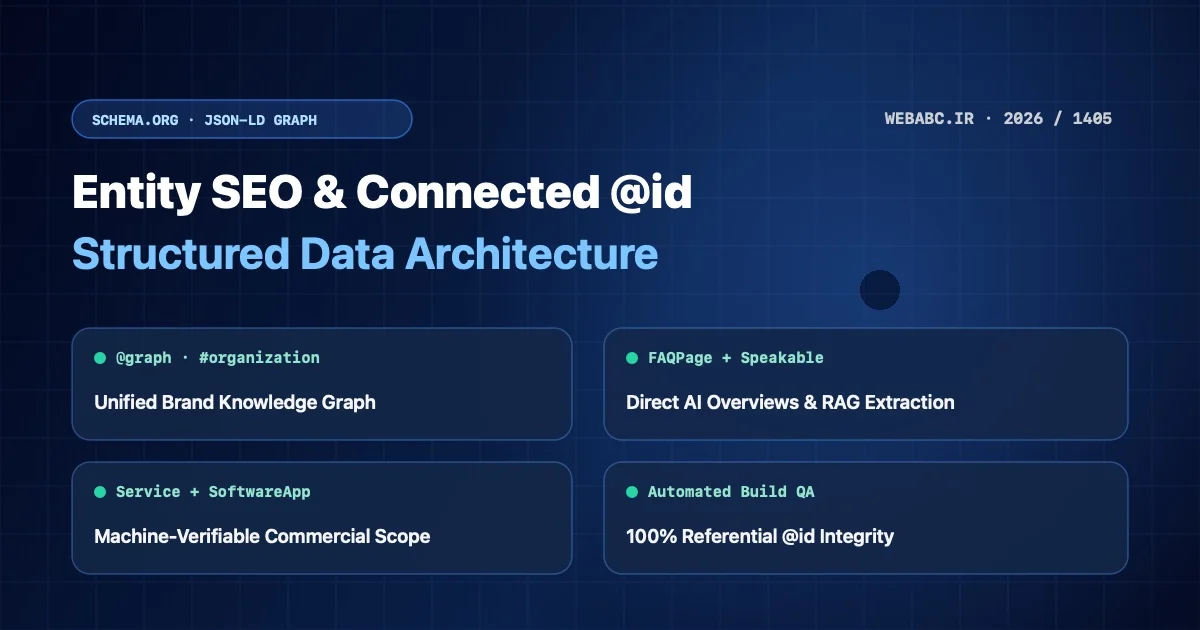
Structured data has evolved from a cosmetic rich-snippet tactic into the primary machine-readable layer between your website, search crawlers, and generative answer engines. When Googlebot or an AI search crawler parses a commercial service page in 2026, clean JSON-LD determines whether your organization is indexed as a verified entity or treated as unstructured prose.
In our own Google Search Console performance export, queries surrounding faq schema generator, faq schema, and best practices for entity seo for brands in 2026 consistently attract technical founders and marketers seeking exact implementation rules rather than high-level theory. This guide details how to design a connected @graph architecture, select durable Schema.org types, eliminate spam-policy violations, and automate graph validation across every build.
What Is JSON-LD Schema Markup and How Does Entity SEO Work?
JSON-LD structured data is a standardized script notation built on Schema.org vocabulary that translates human-readable web content into explicit machine entities, attributes, and relationships without modifying your visual HTML markup. Rather than forcing search parsers to infer whether a phrase names a city, a company division, or a software utility, JSON-LD declares every object unambiguously inside the page head.
Entity SEO advances structured data beyond disconnected page snippets. Instead of pasting repetitive Organization blocks across fifty separate templates, an entity-driven architecture assigns a permanent URI identifier (@id) to every foundational object on your site: the parent company, each localized WebSite, every WebPage, its BreadcrumbList, and the primary Service, SoftwareApplication, or BlogPosting presented on that route.
When those nodes cross-reference one another via isPartOf, mainEntity, about, provider, and publisher, search engines assemble a unified domain knowledge graph. Generative answer engines—including ChatGPT Search, Perplexity, Claude, and Google AI Overviews—depend on that structural disambiguation before citing your pricing models, regional offices, or engineering specifications in synthesized answers.
How @graph and @id Eliminate Brand Ambiguity
Consider what happens when a digital engineering agency publishes pages in English, Persian, and Arabic while serving clients in Dubai, Muscat, Riyadh, Tehran, and Qazvin. Without persistent @id pointers, an AI crawler reading an Arabic landing page can easily treat the Arabic brand transliteration and the English brand name as two unrelated businesses.
By anchoring every locale back to a single root #organization URI—complete with alternateName variants, verified social sameAs profiles, contactPoint channels, and areaServed declarations—every translated route strengthens one canonical corporate identity. You can draft and test this foundational graph inside our free Schema Markup Generator before wiring it into your production layout components.
| Schema Architecture Pattern | Crawler & AI Interpretation | Maintenance Overhead | Entity Authority & GEO Impact |
|---|---|---|---|
| No Structured Data | Relies solely on DOM heuristics and NLP inference | Zero setup, high misinterpretation risk | Weak entity disambiguation in AI Overviews |
| Isolated Plugin Widgets | Emits duplicate, unlinked nodes on every URL | High risk of conflicting phone, logo, or URL values | Fragments Knowledge Graph signals across routes |
Connected JSON-LD @graph |
Single canonical #organization resolved via @id |
Centralized TypeScript helpers, deterministic QA | Strongest Knowledge Graph & AI citation clarity |
Which Schema.org Types Actually Move the Needle in 2026?
Selecting effective Schema.org types means matching each page template to the smallest set of high-signal entities that Google Search Central, Bing, and generative answer engines actively parse and trust in 2026. Stuffing twenty obscure vocabulary classes into a head tag adds zero ranking advantage while multiplying maintenance debt whenever visible copy changes.
Concentrate your engineering roadmap on six core node types that map directly to commercial services, interactive browser tools, regional hubs, and long-form technical guides. Each node type answers a specific retrieval question for crawlers evaluating topical authority and commercial legitimacy.
Six High-Signal Schema Nodes for Commercial Websites
OrganizationandLocalBusiness(orProfessionalService): Establishes legal brand identity,logodimensions,sameAsverification links,contactPointmetadata, andGeoCoordinatesorPostalAddressfor real regional branches. In our Mehromah Mall Qazvin case study, pairing precise local entity markup with sub-second mobile performance supported top Google Maps visibility across a 300-unit commercial complex.WebSite(Scoped Per Locale): Declares the language-specific site container (inLanguage,publisher) cleanly, omittingSearchActionsitelinks markup unless a real query endpoint exists on the domain.WebPagewithSpeakableSpecification: Serves as the canonical document node for each URL and highlights concise summary selectors (such ash1and.aeo-quick-answer) tailored for voice assistants and AI answer extraction.ServiceandOfferCatalog: Defines service scope, target markets (areaServed), and itemized sub-services—essential for technical SEO engagements, local SEO campaigns, and custom web development.SoftwareApplication/WebApplication: Describes interactive browser tools—such as calculators, analyzers, and code formatters—withapplicationCategory,operatingSystem: "All", andisAccessibleForFree: true.BlogPostingPaired withPerson: Connects editorial research to accountable named authors, original publication dates (datePublished), verified content update timestamps (dateModified), and structured topicalkeywords.
Why FAQPage Schema Still Matters for AEO and GEO Citations
Even though Google restricted visual FAQ dropdowns in classic search results primarily to government and healthcare domains, FAQPage JSON-LD remains one of the highest-leverage formats for Answer Engine Optimization and AI citation retrieval. Generative search systems split complex buyer questions into atomic sub-queries, then prioritize pages that supply clean, self-contained question-and-answer pairs.
When your template pairs visible, keyboard-accessible FAQ accordions with a matching FAQPage node—explicitly bound to the document via "isPartOf": { "@id": ".../#webpage" }—retrieval-augmented generation (RAG) pipelines ingest ready-made Q&A passages without scraping surrounding navigation chrome. This structured pairing directly reinforces the passage-citability framework detailed in our Generative Engine Optimization (GEO) 2026 guide.
Four Non-Negotiable Rules for Compliant FAQPage Markup
To keep your FAQPage implementation aligned with search spam policies and genuinely helpful for human visitors, enforce four strict engineering rules across every template:
- Strict Visible Text Parity: Every
Question.nameandAnswer.textstring in JSON-LD must match visible text rendered in the HTML body; collapsed<details>or ARIA-controlled accordions are valid as long as users can toggle them freely. - Exactly One
FAQPageNode Per URL: Never allow both a page template and an imported child component to emit separateFAQPageblocks on the same route; merge page-specific and global questions into one unified array before serializing. - Self-Contained 35–75 Word Answers: Write direct, factual answers that state deliverables, technical constraints, timelines, or pricing variables clearly instead of generic promotional claims.
- Pre-Publish Validation Workflow: Generate clean question arrays in our FAQ Schema Generator and verify bracket and escaping integrity inside the JSON Formatter & Validator.
How Do You Architect a Connected JSON-LD @graph Step by Step?
Engineering a reliable JSON-LD @graph starts with a single canonical URL helper module so every layout, breadcrumb, service card, and FAQ component computes identical trailing-slash URLs and #fragment identifiers. A one-character mismatch between /en/services/seo#webpage and /en/services/seo/#webpage severs the graph edge and leaves dangling references in validator tools.
In an Astro, Next.js, or TypeScript codebase, isolate identity generation in a dedicated helper module that enforces trailing slashes and deterministic fragment suffixes:
export const SITE_ORIGIN = 'https://webabc.ir';

export function canonicalPageUrl(pathname: string): string {
  const normalized = pathname.endsWith('/') ? pathname : `${pathname}/`;
  return `${SITE_ORIGIN}${normalized}`;
}

export const webpageId = (pageUrl: string) => `${pageUrl}#webpage`;
export const breadcrumbId = (pageUrl: string) => `${pageUrl}#breadcrumb`;
export const websiteId = (lang: string) => `${SITE_ORIGIN}/${lang}/#website`;
Composing WebPage, Service, and Speakable Nodes Together
Once every component imports from that shared identity module, your service route can emit a clean @graph array where #webpage references #website and #organization, declares #service as its mainEntity, and exposes SpeakableSpecification selectors (h1 and .aeo-quick-answer) without colliding with child components. When rendering a shared FAQ component on that same route, pass a boolean prop such as emitWebPage={false} so the FAQ script attaches "isPartOf": { "@id": ".../#webpage" } without redeclaring a second WebPage block.
This modular pattern scales cleanly across complex B2B verticals—such as industrial web design, multilingual export portals, and enterprise ERP/CRM automation—while keeping every JSON-LD payload compact, readable, and easy to unit-test.
What Common Structured Data Mistakes Trigger Penalties or Rejection?
Most structured data failures in production are caused not by malformed JSON syntax, but by semantic dishonesty, broken @id pointers, or automated SEO plugin defaults that contradict visible page elements. Modern indexing pipelines cross-examine your structured claims against rendered DOM text, HTTP status codes, and historical crawl diffs.
Across dozens of commercial codebases reviewed during technical SEO audits, five recurring structured data mistakes account for the vast majority of Rich Results warnings and ignored entity graphs:
| Structured Data Anti-Pattern | Why Search & AI Parsers Reject It | Permanent Engineering Fix |
|---|---|---|
Hardcoded AggregateRating (4.9/5) |
Violates Google self-serving review spam guidelines | Strip rating nodes unless backed by verifiable user-submitted reviews |
Unwired SearchAction Sitelinks Target |
Points to a search URL parameter that 404s or renders static content | Remove potentialAction on sites without a live search index |
Duplicate #webpage Declarations |
Layout and FAQ widget both emit #webpage with different properties |
Centralize #webpage ownership and disable duplicate child emission |
QAPage Used on Editorial FAQ Lists |
QAPage requires community-submitted alternative answers per question |
Replace QAPage with FAQPage for brand-authored Q&A sections |
Build-Time dateModified Stampeding |
Updating dateModified on every deploy trains crawlers to distrust timestamps |
Bind dateModified to real git commit timestamps or explicit editorial updates |
Why Honest Metadata Outperforms Aggressive Markup
Attempting to game rich results with synthetic review stars, hidden HowTo steps, or inflated offer ranges backfires in both classic search and generative engines. A clean, truthful graph covering Organization, WebPage, BreadcrumbList, Service, and visible FAQPage items builds durable trust without risking a site-wide structured data manual action.
How Should Multilingual Sites Localize Schema Across EN, FA, and AR?
On a multilingual architecture, entity URIs that represent shared organizational truth remain language-neutral, whereas page URLs, titles, descriptions, breadcrumbs, and inLanguage tags localize strictly per language subfolder. Preserving that distinction unifies brand authority across English, Persian, and Arabic while preventing cross-language snippet contamination in regional SERPs.
Apply four concrete localization standards across /en/, /fa/, and /ar/ templates:
- One Global Organization
@id: Point every locale’spublisherandproviderproperty to the same root#organizationidentifier while listing English, Persian, and Arabic brand names insidealternateName. - Locale-Scoped
WebSiteandWebPageNodes: Scope site and document URIs per language folder (/en/#website,/fa/#website,/ar/#website) soisPartOfchains stay strictly within the active language tree. - Accurate BCP-47 Language Tags: Output
en-US,fa-IR, andar-SAdynamically based on the active route locale rather than leaving a static English string inside RTL templates. - Aligned Hreflang and Canonical Signals: Ensure the
urlinside everyWebPageJSON-LD node matches the page’s<link rel="canonical">and reciprocalhreflangcluster character for character, including the trailing slash.
Step-by-Step Automated Schema QA Checklist Before Deployment
Treat JSON-LD structured data as production code by running automated post-build verification scripts against your compiled HTML files before any release deploys to edge servers. Manual inspection in browser developer tools only checks a single route at a time, whereas a build-gate script audits hundreds of localized pages in under two seconds.
Add these five automated checks to your continuous integration pipeline:
- Strict JSON Parsing Gate: Parse every
<script type="application/ld+json">block acrossdist/**/*.htmland fail the build immediately on syntax errors,undefinedinterpolations, or empty objects. - Same-Document
@idResolution: Verify that every internal@idtarget referenced byisPartOf,mainEntity,mainEntityOfPage,breadcrumb, orpublisherexists within that same HTML document’s combined@graph. - Speakable DOM Selector Verification: Confirm that selectors declared inside
SpeakableSpecification(such ash1and.aeo-quick-answer) match non-empty elements in the compiled HTML body. - Prohibited Type Guardrail: Assert that banned or unverified schema classes—such as
AggregateRating,QAPage, or unwiredSearchAction—never slip in through third-party components. - Post-Deploy Validator Spot-Check: Validate representative homepage, service, tool, and article URLs in Schema Markup Validator and Google Rich Results Test, or work directly with our SEO engineering team and explore our Website Cost Calculator to scope a complete technical SEO and GEO upgrade.