Your title tag is the single highest-leverage line of copy on your website: it determines whether a ranking page actually earns the click. Two results can sit one position apart on Google with a 3x difference in click-through rate, and the title is almost always why. Here’s the system we use to write headlines that rank and convert.
1. The 50–60 Character Rule (and Why It’s Really 580 Pixels)
Google truncates titles by pixel width (~580px desktop), not character count, but 50–60 characters is the practical working range that keeps most titles fully visible on desktop and mobile SERPs.
Practical implications:
- Narrow characters are free:
i,l,t, and spaces take far fewer pixels thanW,M, or uppercase-heavy text. A 62-character title in lowercase can survive intact while a 54-character ALL-CAPS title gets cut. - Front-load everything that matters: the keyword, the number, and the value proposition should appear in the first 40 characters so truncation never removes the reason to click.
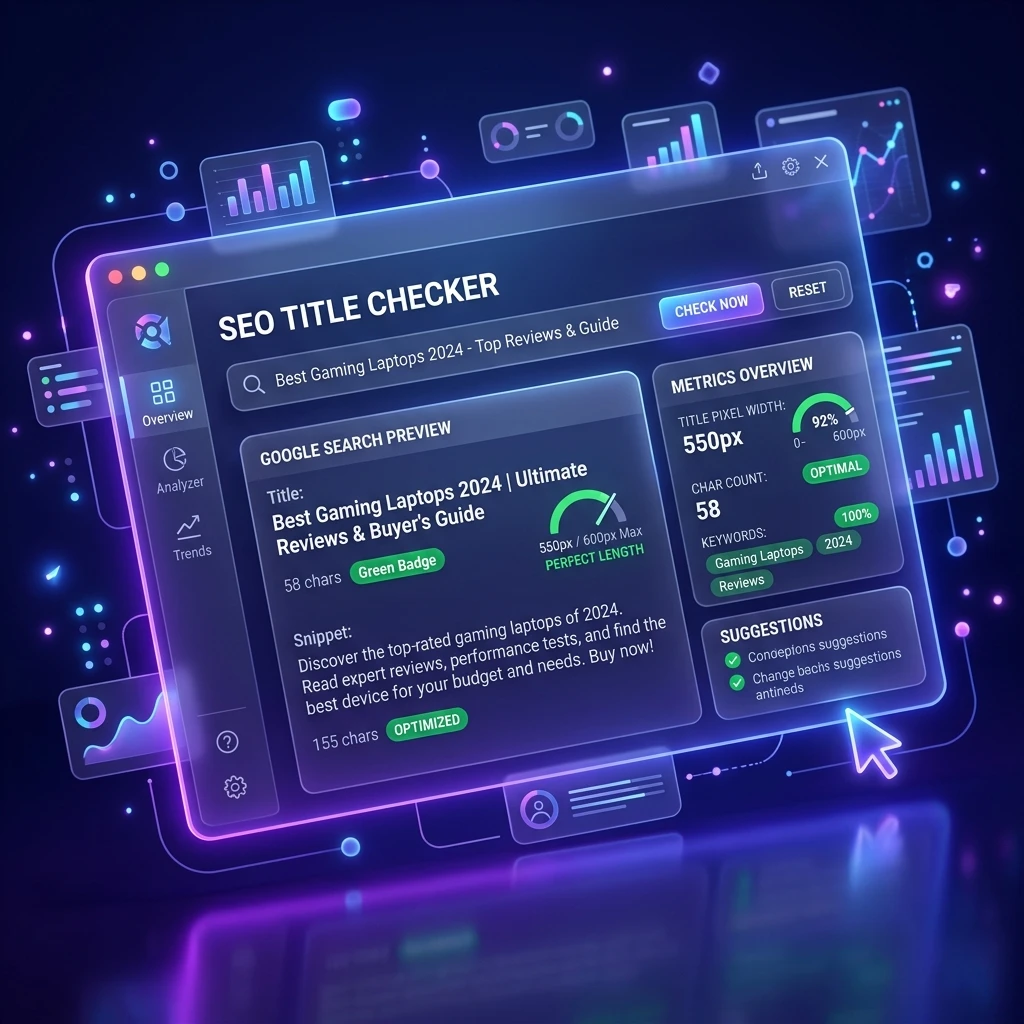
- Test, don’t guess: preview exactly how your title and meta description render — including pixel-based truncation points — with our free [SEO Title Checker](/en/tools/headline-analyzer/.
- Avoid duplicated suffixes: if Google appends your brand name automatically, writing it in manually wastes 10–15 pixels you could spend on persuasive copy.
2. Power Words and Emotional Triggers
Certain words consistently lift click-through rates because they promise speed, certainty, or insider knowledge. The highest-performing categories:
- Speed and ease: Easy, Fast, Simple, Instant, Effortless — these reduce the perceived cost of clicking.
- Authority and proof: Proven, Definitive, Complete, Ultimate, Data-Backed — these promise the reader won’t need a second click.
- Curiosity gaps: Secrets, Mistakes, Nobody Tells You, Hidden — these imply information advantage, but only use them when the content genuinely delivers, or bounce rate will punish the ranking.
- Urgency: 2026, Now, Today, Before You — freshness signals matter for both CTR and Google’s freshness ranking signals.
The formula that outperforms generic phrasing in our title audits: [Number or Trigger Word] + [Keyword] + [Specific Outcome or Modifier]. Compare “Writing Headlines Guide” against “11 Proven Headline Formulas That Double Your CTR (2026)” — same topic, radically different click behavior.
Critical caveat: clickbait that overpromises destroys you twice — once in bounce rate and dwell time signals, and again in Google’s repeated-click measurement. Persuasion and honesty are not enemies; the best headlines compress a truthful promise into its most compelling form.
3. Number-Driven Titles and Listicle Structure
Numbers work because they set a concrete expectation: the reader knows exactly how much they’re committing to, and odd/scannable numbers imply curated rather than padded lists.
Specific techniques:
- Odd numbers outperform round ones in most CTR studies — “7 Strategies” feels more curated than “10 Tips.”
- Brackets and parentheses add clarification without clutter: “(Free Template)”, “[Updated 2026]”, “(With Examples)” — these consistently lift CTR because they answer “what exactly do I get?” before the click.
- Match the number to the content honestly: a “7 Ways” headline on a post with three shallow items erodes trust and dwell time.
- Years signal freshness: appending the current year (“2026 Guide”) tells both searchers and Google the content is maintained — but only when you’ve actually updated it.
4. SERP CTR Psychology: Winning the Click From Position 3
Position on the SERP doesn’t determine clicks; relevance plus packaging does. A well-written title at position 4 routinely out-clicks a lazy title at position 2. The psychological levers that drive SERP selection:
- Information gain promise: users scan titles for what’s different from the other nine results. If every title says “Complete Guide,” yours should say “With Checklist” or “Common Mistakes Included.”
- Intent mirroring: the title should echo the searcher’s exact problem. Someone searching “why is my wordpress site slow” clicks “Why Your WordPress Site Is Slow (7 Causes, Ranked by Likelihood)” over “WordPress Speed Optimization Tips.”
- Rich snippet synergy: titles perform differently when surrounded by rich results — FAQ accordions, review stars, breadcrumbs. Stand out against what actually renders, not the raw ten blue links.
- Brand recognition: if your brand is known in the niche, the brand suffix lifts CTR; if it isn’t, spend those pixels on persuasion instead.
5. A/B Testing Headlines: Titles, H1s, and Title Tags
Headline testing happens at three different layers, and each has different rules:
- Title tags (SERP): you can’t run a true split test on Google, but you can change a title tag and measure CTR in Search Console before/after, controlling for position. Change one variable at a time and give it 3–4 weeks of impression data before judging.
- H1 and on-page headlines: true A/B testing works here — tools like VWO, Google Optimize alternatives, or your own feature flags can split traffic. Test emotional vs. utility framing, question vs. statement formats.
- Social and email headlines: the cheapest testing ground. Run the same article with two subject lines or social headlines and let engagement data inform which angle deserves the title tag.
Keep a title change log per page so SEO movement is attributable; undocumented title edits make ranking diagnosis impossible months later.
6. Common Headline Mistakes That Kill CTR
The most frequent failures we see in content audits:
- Duplicate or near-duplicate titles across category archives, pagination, or similar posts — Google consolidates them and your CTR splits.
- Keyword stuffing: repeating “cheap” or “best” three times in one title reads as spam to users and triggers quality signals in ranking systems.
- All caps and excessive punctuation — TITLES LIKE THIS!!! get skipped by users trained to avoid ad copy.
- Titles that answer nothing: “About Our Services” vs. “Web Design Services in Toronto: Pricing, Timeline, and Process” — specificity wins every time.
- Orphaned keywords in the middle: if the target keyword appears after character 60, you’ve optimized the truncation remnant, not the visible title.
Conclusion
Clickable headlines are a system, not a talent: respect the ~580px budget, front-load the keyword and hook, use numbers and one power word, mirror searcher intent, and test title-tag changes against Search Console CTR data. Sites that treat titles as an afterthought leave 20–40% of their ranking potential uncollected in every SERP they appear in.
Score your headline before you publish with our free Headline Analyzer — it checks length, power words, sentiment, and structure in real time. And if you want headlines written as part of a full content strategy, our Content Creation services deliver SEO-optimized articles end to end. Contact WebABC to discuss your content goals.
References and Further Reading
- Google Search Central — Influencing your title links in search results: Google’s official documentation on how title tags are generated and how to write titles that survive truncation and earn clicks.
- Google Search Central Blog — An update to how we generate web page titles: the 2021 change confirming
<title>elements are used ~80–87% of the time, which is why title-tag quality matters more than ever. - Google Search Central Blog — More information on how Google generates titles: follow-up guidance on writing HTML title elements and what Google does when titles are missing or unhelpful.
- Google Search Central — SEO Starter Guide: the fundamentals of influencing your site’s appearance in search, including title links and snippets.