Expanding across the Middle East, the Gulf Cooperation Council (GCC), and global export corridors requires far more than installing a translation plugin on a single-language website. When procurement buyers in Dubai, Muscat, Riyadh, Tehran, or London evaluate a supplier online, broken right-to-left (RTL) alignment, mismatched hreflang snippets, or sluggish cross-border TTFB erode trust before a conversation ever starts.
Across our regional deployments and Search Console data—spanning queries on Arabic SEO, international web design, and cross-border B2B platforms—the gap between machine-translated templates and natively engineered multilingual architecture consistently decides which brand wins organic visibility. This guide breaks down URL topology, reciprocal hreflang parity, HTTP 302 edge routing, CSS Logical Properties for RTL/LTR interfaces, self-hosted variable typography, and automated CI checks for English, Persian, and Arabic websites in 2026.
Which URL Structure Works Best for Multilingual SEO in 2026?
Language subdirectories on a single canonical domain—such as /en/, /fa/, and /ar/—deliver the cleanest balance of consolidated backlink authority, crawl efficiency, and unified Cloudflare Edge routing for most cross-border companies. Unlike separate country-code domains that start from zero authority in every market, subdirectories let every editorial backlink and case study lift all locales together.
Before committing your engineering team to a routing model, compare the three standard international URL topologies against your operational and compliance requirements:
| URL Topology | Example Pattern | Domain Authority Sharing | Engineering & Edge Ops | Best Commercial Fit |
|---|---|---|---|---|
| Language Subdirectories | webabc.ir/en/, /fa/, /ar/ |
Unified domain authority across all locales | Single Worker, single build & SSL pipeline | Export brands, B2B SaaS, regional agencies |
| Language Subdomains | ar.webabc.ir, en.webabc.ir |
Partially split; crawlers often treat separately | Separate DNS, cookie scoping & Search Console setups | Legacy monoliths isolating regional teams |
| Country ccTLDs | .ae, .sa, .om, .co.uk |
Zero shared authority; separate link building per TLD | Highest legal, renewal & multi-repo overhead | Regulated banks or state-mandated local entities |
Why Slug Parity Across Locales Prevents Indexation Drift
On a subdirectory architecture, enforcing strict slug parity—where /en/export-web-design/, /fa/export-web-design/, and /ar/export-web-design/ share the exact same ASCII route identifier—simplifies routing, sitemap generation, and language switching. Users toggling between Arabic and English mid-session land on the exact equivalent document rather than getting dumped back onto a generic homepage, and build scripts can verify 1:1 route completeness deterministically. Clean, ASCII-safe slugs can be standardized with our URL Slug Generator.
Keeping route slugs uniform across languages also simplifies analytics cohort comparison in Google Analytics 4 and Search Console. By stripping the leading two-letter locale segment in a single regex expression, product and SEO teams can compare conversion rates, scroll depth, and query impressions for the exact same service or guide across English, Persian, and Arabic audiences.
How Do Reciprocal Hreflang Clusters and x-default Actually Work?
Hreflang annotations instruct Google and regional search engines which localized URL version belongs in each user’s search results, preventing duplicate-content cannibalization and wrong-language snippets across international markets. However, search engines enforce strict reciprocity: if Page A in English links to Page B in Arabic, Page B must link back to Page A using identical canonical URLs.
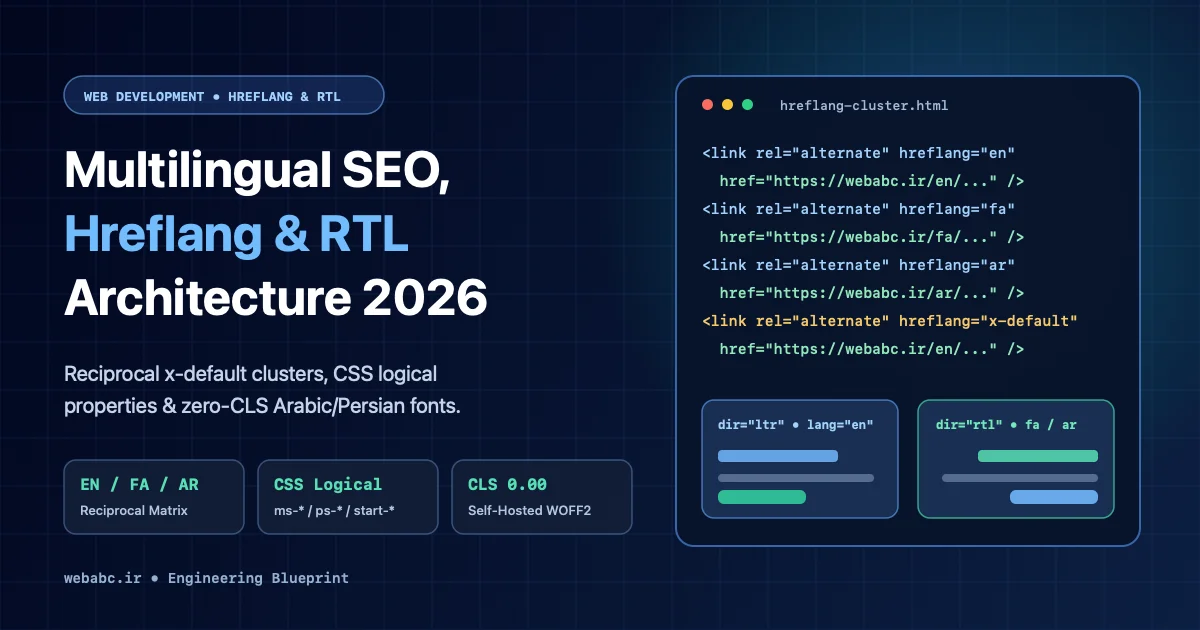
Every indexable HTML document (or XML sitemap <url> entry) in a trilingual site must declare the complete cluster—including a self-referencing link for the active locale and an x-default fallback pointing to your neutral language selector or default international route:
<link rel="canonical" href="https://webabc.ir/en/export-web-design/" />
<link rel="alternate" hreflang="en" href="https://webabc.ir/en/export-web-design/" />
<link rel="alternate" hreflang="fa" href="https://webabc.ir/fa/export-web-design/" />
<link rel="alternate" hreflang="ar" href="https://webabc.ir/ar/export-web-design/" />
<link rel="alternate" hreflang="x-default" href="https://webabc.ir/en/export-web-design/" />
Avoiding the HTTP 301 Root Redirect Trap
One of the costliest mistakes in international web engineering is placing a permanent 301 geo-redirect on the root / URL. Because Googlebot crawls predominantly from United States IP addresses, a 301 redirect from / to /en/ teaches caches and crawlers that other locales are permanently superseded, while locking traveling users into the wrong language.
Always serve root / geo-routing or Accept-Language negotiation with an explicit HTTP 302 Found status code and Cache-Control: private, no-store, while keeping every /en/, /fa/, and /ar/ URL directly accessible at HTTP 200 regardless of visitor IP. That exact pattern powers our export web design architecture and keeps every regional tree crawlable worldwide.
Pair that 302 root dispatcher with a persistent user-preference cookie whenever a visitor manually clicks the header language switcher. Respecting explicit user choice over raw IP geolocation ensures an Arabic-speaking executive browsing from a London hotel or a European VPN stays in /ar/ across future sessions without frustrating redirect loops.
How Do You Engineer Native RTL and LTR Layouts Without CSS Bloat?
Engineering seamless bilingual or trilingual interfaces starts by setting dir="rtl" or dir="ltr" and lang directly on the root <html> element, then writing layout spacing exclusively with CSS Logical Properties. Legacy codebases that build pages with margin-left, padding-right, and text-left end up maintaining hundreds of brittle [dir="rtl"] override rules that break on every redesign.
Modern Tailwind CSS v4 and native browser layout engines map inline-start and inline-end coordinates automatically to the reading direction of the active locale:
- Spacing & Margins: Replace
ml-4andpr-6withms-4(margin-inline-start) andpe-6(padding-inline-end) so badges, icons, and form controls align naturally in both English and Arabic/Persian. - Borders & Callout Stripes: Use
border-s-4(border-inline-start-width) on blockquotes and AEO quick-answer capsules so the accent bar sits on the left in English and flips cleanly to the right in Persian and Arabic. - Absolute Positioning: Swap
left-4and-right-4forstart-4and-end-4on modal close buttons, step badges, and dropdown menus. - Directional Icons & Numeric Tokens: Flip directional progress arrows (
→vs←) based onisRtl, while wrapping international phone numbers (+98...), code snippets, URLs, and API keys inside<span dir="ltr">so bidirectional punctuation never scrambles digits.
Typography and Line-Height Tuning for Arabic and Persian Scripts
Arabic and Persian scripts have taller ascenders, deeper descenders, and connected cursive letterforms that look cramped when rendered with Latin font sizes and tight 1.1 headline line heights. Self-host dedicated WOFF2 variable fonts—such as Inter for Latin, Vazirmatn for Persian, and Cairo or IBM Plex Sans Arabic for Arabic—with font-display: swap, zero external Google Fonts requests, and relaxed body line-height (1.75 to 1.9) so long-form guides remain effortless to scan on mobile screens.
Disable positive letter-spacing (tracking-wide or tracking-widest) on Arabic and Persian headings as well. While uppercase English eyebrow badges benefit from slight tracking, adding horizontal space between cursive Arabic or Persian characters severs ligature connections and makes headlines look broken across Safari and Chrome.
Why Cultural UX and Intent Localization Beat Machine Translation
Ranking and converting in Dubai, Riyadh, Muscat, and Tehran requires researching native search vocabulary, commercial trust expectations, and payment workflows in each language rather than translating English headings literally. A procurement director searching in Arabic in Saudi Arabia uses entirely different terminology and compliance criteria than a Persian industrial buyer in Qazvin or an English-speaking importer in London.
In our ODYPS multilingual luxury rug platform, tailoring navigation, product schema, and regional search copy for Oman and European buyers drove +210% organic search growth alongside a 96/100 PageSpeed score. Likewise, on the Mahsun Visa multi-region portal, structuring distinct user journeys across UAE, Turkey, and Canada intents turned complex cross-border service queries into qualified consultations.
Regional Trust, Payment Rails, and Local Search Signals
When rolling out localized commercial hubs across Dubai and the UAE, Riyadh and Saudi Arabia, or Muscat and Oman, align four high-impact conversion layers per locale:
- Native Keyword & SERP Mapping: Research actual Search Console and People-Also-Ask phrasing in each script, then craft pixel-accurate localized titles (
<= 60characters) and meta descriptions (150–160characters) using our Meta Tag Generator. - Market-Specific Payment & RFQ Flows: Highlight Mada, Apple Pay, Tabby, and Tamara for GCC retail checkouts, Shaparak and official tax-invoice workflows for Iranian commerce, or multi-currency proforma RFQ pipelines for B2B exporters.
- Numeral & Date Conventions: Format dates, currencies, and metrics cleanly per audience (
2026vs۱۴۰۵, Eastern vs Western Arabic numerals where appropriate) while keeping JSON-LD ISO dates (YYYY-MM-DD) machine-standard. - Localized Proof & Case Evidence: Surface case studies and regulatory credentials relevant to the buyer’s region rather than generic global filler.
How Should AI Crawlers and llms.txt Handle Multilingual Corpora?
Generative search crawlers and LLM retrieval agents consume multilingual websites far more accurately when each language tree exposes its own localized llms.txt index, llms-full.txt corpus, and Accept: text/markdown content negotiation. Feeding an English-only llms.txt file to an agent answering a Persian or Arabic prompt forces cross-language translation hallucinations on your brand’s pricing and service scope.
Structure your agentic discovery layer with strict symmetry across /en/, /fa/, and /ar/:
- Root + Per-Locale
llms.txtIndexes: Maintain a concise root/llms.txtindex linking to/en/llms.txt,/fa/llms.txt, and/ar/llms.txt, with identical section structures and link parity across all three locales. - Markdown Negotiation on Every Locale URL: Configure your edge Worker so requesting
Accept: text/markdownon/ar/services/web-development/or/fa/export-web-design/returns clean, token-efficient Markdown in that exact language. - Unified Machine-Readable Catalog: Publish a structured
/ai-catalog.jsonmanifest mapping every interactive tool and agency service across all supported languages so autonomous agents route users to the right localized utility.
Pair those machine-readable manifests with explicit crawler permissions inside robots.txt for modern search and citation bots—such as OAI-SearchBot, Claude-SearchBot, PerplexityBot, and Google-Extended—while keeping /api/ and /private/ disallowed inside every bot block so RFC 9309 group overrides never expose internal routes.
What Technical Pitfalls Sink International Websites After Launch?
Even well-designed multilingual websites frequently lose search visibility months after launch because editorial updates, font loading, or sitemap generators introduce silent parity regressions across locales. Catching these failure modes early saves months of wasted crawl budget and lost regional rankings.
Watch for these five recurring engineering pitfalls during ongoing site operations:
| Multilingual Pitfall | Search & UX Consequence | Engineering Prevention |
|---|---|---|
| Orphaned Single-Locale Blog Posts | Breaks hreflang cluster symmetry; triggers build or 404 errors on language switcher |
Require simultaneous en, fa, and ar MDX files per slug in CI |
| Hardcoded Single-Script Font Classes | Applying a Persian font class globally distorts English kerning or Arabic glyph shaping | Compute fontClass dynamically from the active lang parameter |
| Mixed-Language JSON-LD Nodes | Arabic URL emits English inLanguage: "en-US" or English breadcrumb labels |
Bind all schema strings and BCP-47 tags to the route’s locale dictionary |
| Third-Party Font CDN Blocking | External font requests increase TTFB and fail on restricted regional networks | Self-host subsetted WOFF2 variable fonts directly under /fonts/ |
Identical Global Sitemap lastmod |
Overwriting every locale’s <lastmod> on minor CSS edits dilutes crawl priority |
Resolve lastmod per locale file from actual content git history |
Audit XML sitemaps and edge response headers alongside those manifests so every localized route returns consistent Content-Language metadata, clean canonical tags, and fast edge cache hits across Dubai, Riyadh, Muscat, Tehran, and European points of presence.
Pre-Launch Multilingual Engineering & SEO Verification Checklist
Automating multilingual parity checks inside your continuous integration build pipeline guarantees that no broken hreflang loop, missing translation dictionary key, or right-to-left layout overflow ever reaches production as your content library scales. Before shipping any international release to edge servers, execute this six-point engineering verification gate:
- 1:1 Route & Slug Parity Gate: Assert that every static page, service route, portfolio item, and blog slug exists across
/en/,/fa/, and/ar/with zero missing counterparts. - Reciprocal Hreflang & Canonical Audit: Parse compiled HTML across all locales to confirm every
hreflanglink returns HTTP200, includesx-default, and matches each target page’s<link rel="canonical">. - RTL & 320px Viewport Stress Test: Inspect Arabic and Persian pages at
320px,390px,768px, and1440pxviewports to verify zero horizontal scrollbars, logical icon placement, and44x44pxminimum touch targets. - Core Web Vitals & Edge TTFB Check: Measure LCP (
<= 2.5s), INP (<= 200ms), and CLS (<= 0.1) per locale with self-hosted WOFF2 fonts and AVIF/WebP imagery. - JSON-LD &
llms.txtLocale Parity: Verify thatinLanguage,#websiteURIs, and/en/llms.txt,/fa/llms.txt, and/ar/llms.txtlink counts align cleanly across all languages. - Scope Your Cross-Border Architecture: Ready to engineer a high-speed multilingual platform? Explore our custom web development services, review our B2B export web design blueprint, or calculate your project scope instantly in our Website Cost Calculator.